Even if you’re not particularly superstitions, we all know that if you accidentally spill salt, you’re supposed to throw it over your left shoulder. We’re not meant to walk under ladders. And God forbid you cross a black cat in your path.
But for Southern Italians, this is just the surface. We’re deeply superstitious, a trait likely inherited from Ancient Romans who read omens in everything from bird flight to spilled wine.
And that way of thinking never really left us. We’re still a people of ritual and instinct: we cover mirrors when someone dies, we flinch when someone opens an umbrella in the house, and we ward off the malocchio with olive oil and a prayer.
In Italian life, the sacred and the profane often overlap.
These beliefs are stitched into our daily lives, passed down through hushed whispers from observant (and – if I’m being honest – judgemental) nonne. Nobody recalls when they learned of these superstitions; they were just understood and accepted with a solemn nod.
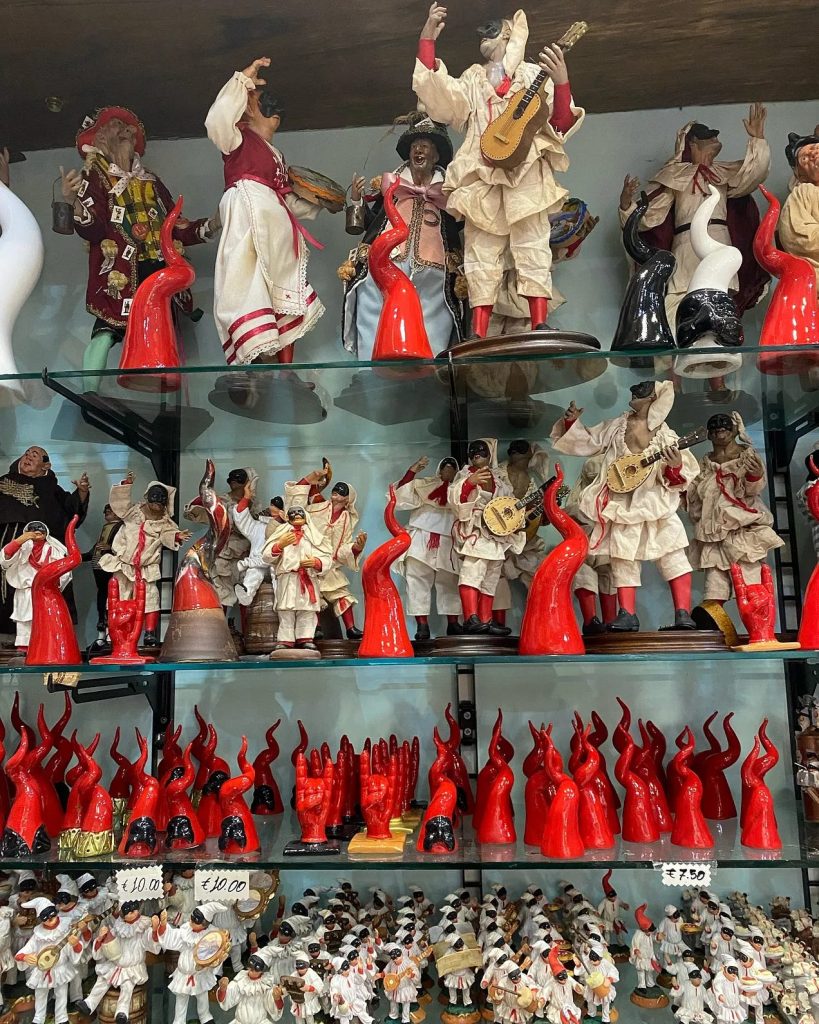
Call it folklore, call it fear, call it a beautifully irrational way of staying connected to something older than logic. We half-believe it, fully practice it, and never quite resolve the contradiction.
There’s even a saying: Non è vero, ma ci credo. “It’s not true, but I believe it.” Or as I’d put it: “I’m pretty sure this is all a pile of caca, but what if I’m wrong?”
Blurring the lines between sacred and profane
And yet here’s where it gets complicated for me. Catholicism is full of the mystical: holy water, travelling relics, and prayers for specific intercessions, to name a few. When I bless myself before a flight, is that faith or superstition? When I touch a saint’s medal in my pocket without thinking, am I praying or hedging my bets?
Maybe the answer is both.
Superstitions may not be “Vatican-verified,” but the sacred and profane coexist so closely in Italian life that they often become indistinguishable, for both outsiders and those raised within it.
What began as inheritance became necessity
This kind of blurring has deep roots. Long before modern Italy took shape, people used stories, habits, and little rituals to understand the world and feel safe.
Antonio Gramsci wrote about how Southern Italy came to be labelled “superstitious” in the early 20th century, in contrast to a North that had greater access to education, medicine, and state institutions.
This imbalance was evident, and played out in everyday life for the Southern people. When you don’t have a doctor, you go to the lady in the village who knows the prayers and the herbs. When no one teaches you science, you learn what your nonna learned from her nonna. You make sense of the world with the tools you have.
From the outside, that way of life was easy to misread.
The rich North looked at the poor South and said: “Look how superstitious they are. How backward. How ignorant.”
But Gramsci said: hang on. They’re not superstitious because they’re stupid. They’re “superstitious” because they were denied schools, hospitals and opportunity. And so belief filled the gaps where these institutions failed.
The superstitions that stayed with us
And like most folk magic, there’s no rulebook: only local variations, handed down community by community, region by region. What wards off evil in Abruzzo might mean nothing in Puglia.
Here are the superstitions that shaped my childhood (and still hold some power over me now). Let me know if you’ve heard of them too.
The body knows
- A menstruating woman should never knead bread dough. It won’t rise properly and will have no flavour. She shouldn’t touch flower buds (they won’t bloom) or preserved foods (they’ll spoil).
- When talking about illness, don’t gesture to that part of the body. You’ll invite that illness into yourself. Same goes for touching someone else.
- If your eye twitches, someone’s thinking of you. Whether it’s good or bad news depends on which eye and whether you’re male or female (I’ve never been able to keep the rules straight.)
- If your left palm itches, you’ll lose money. But if your right palm itches, you’ll be receiving money.
- Touching a hunchback’s hump brings good luck. Attempt at your own peril. I don’t think a stranger in Italy would take it well if you walked up to them and touched their back. But they’d get it.
Superstitions about death and the dead
- Cover the mirrors when someone in the family dies. If the body is reflected, the soul gets trapped, and the house gets haunted. Don’t ask.
- Never place a hat on a bed. That’s what priests did when visiting the dying.
- Don’t put new shoes on the table. Especially black ones. It’s a death omen. No matter how many times I tell my husband, he still continues to do it and gives me a conniption.
- Dreaming of teeth falling out foretells death. My sister once dreamt of her teeth falling out, and black pus filled the gaping hole. A few days later, her best friend was hospitalised from a drug overdose.
Babies and children
- Never step over a child lying on the floor. It stunts their growth. If you do it by accident, stop and step back over them to undo the damage.
- Pregnant women shouldn’t wear necklaces or eat ring-shaped foods. This one comes from Piemonte and ties back to the masche (local witches known for targeting children). The ring shape is a bad omen for the umbilical cord, without stating the obvious.
- Baby gifts wait until the final weeks, or after birth. Celebrating too early is said to tempt fate, risking the baby’s health and safe arrival.
Money and fortune
- Never put your wallet on the floor. Call it coincidence, but I’ve lost count over how many times I’ve thrown my bag haphazardly on the floor when arriving home only to be met with bills coming out of my ears within the week.
- Never gift pearls. You must buy your own. If someone gives you pearls, hand them a coin: you’re “buying” them to dodge the bad luck.
- When gifting a wallet, put money in it. An empty wallet wishes poverty on the receiver.
Days of the week to avoid
- Fridays are not for celebrating. Unless it’s the exact day of a birthday, holiday, or anniversary, try to avoid hosting a party on that day. There’s a saying: “Cu ridi di venniri, chianci di domenica”; which roughly translates to: ‘If you laugh on Friday, you’ll cry on Sunday.’ So far, I’ve found it to be true.
- On Fridays and Tuesdays, don’t marry, don’t travel, and don’t start anything new. Friday is the day Christ was crucified. Tuesday takes its name from Mars, god of war, and Constantinople fell on a Tuesday. Both days are cursed for new beginnings.
Superstitions for around the house
- Before throwing away bread, kiss it. Wasting bread is a disgrazia, but the kiss softens the sin.
- Don’t pass sharp objects hand to hand. Handing knives, scissors or anything with a blade is said to directly “cut” the relationship. Put it down and let them pick it up.
- Bring your washing in before nightfall. If clothes stay on the line overnight, the gypsies will curse them. Wash them again. Then change your bedsheets every three days, just to be safe.
- Never sweep over someone’s feet. If someone sweeps over your feet, you will never get married. This probably explains why everyone jumped out of the way when my mother was sweeping the kitchen.
- Hang a small twig broom by the door. In Abruzzo, my nonna used to say it kept witches from crossing the threshold because they’d stop to count the twigs, one by one, and by the time they were finished, morning had already arrived. Why are witches coming to your door? To steal your newborn baby, of course.
Superstitions at the table
- Avoid seating 13 at the table. This traces back to the Last Supper, where thirteen guests were present before the crucifixion. Bad news ever since.
Until next time —
A dopo

Hero image by Anders Jildén